From the pompadour to the moptop to the metal mane to whatever it is Lady Gaga has atop her head, here is a history of popular music as told through the notable haircuts on this signed, limited edition print.
If you pre-order a print by this weekend, you get 20 percent off.
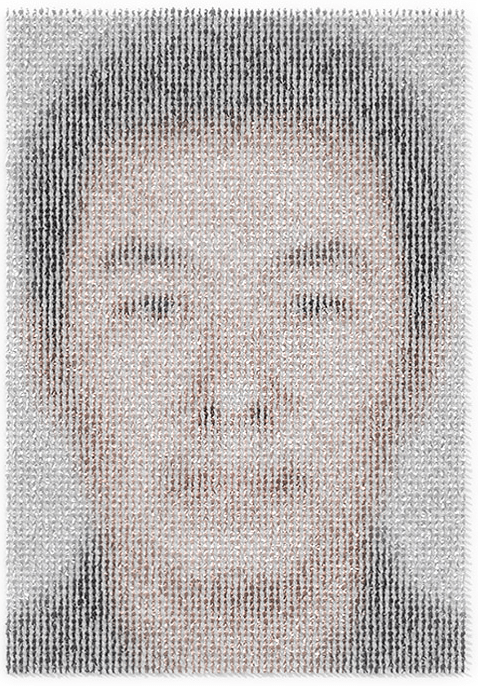
Continuing their series on world population, National Geographic focuses in on the “most typical” person in the world. The above image is an artist’s rendering of the average face computed by the Chinese Academy of Sciences in Beijing. Zoom in and you’ll see that the face is made of 7,000 human figures, as shown below. It’s true. I counted.
The face is based on photos collected over ten years from several national technology research programs, however, it only seems to be Chinese faces. If that’s the case, then obviously it’s not really the “face of seven billion.” It’s also not the world’s most typical person. The video below has some similar weird logic.
Okay, wait. I got it. Think of it like this: by “typical” they’re referring to mode rather than mean or median. Still though, the feature is better labeled as the face of China. Oh forget it. It is what it is.
America, the champion of democracy and freedom, actually has more Internet censorship than some countries in Africa and South America according to an infographic based on Internet censorship research conducted by the OpenNet Initiative.
The U.S. and Canada are listed as “some censorship” along with much of Western Europe. Russia and Australia ranked lower as “Under Surveillance,” while China and parts of the Middle East ranked at the bottom for “Pervasive Censorship.”
As for what kinds of content is censored, the research found that “blogs” were the most censored content at 20% while “militant groups” only ranked at 1%. Surprisingly, locally focussed NGOs tied for third-most censored at 9%.
Even though the research from OpenNet comes from top minds at at The Citizen Lab, University of Toronto, and the Harvard Law School, it raises some inherent problems with defining “censorship.” For example, screening out child pornography and illegal file sharing technically registers as “censorship” even though most people wouldn’t consider that a human rights offense. It would be naive, however, to assume that all that surveillance was well-intentioned, especially when applied in countries that restrict social networking sites or limit access to the Internet.
Perhaps that’s why locally focussed NGO’s sometimes rank so highly in types of censored content. Quashing protest or opposition is much different from removing illegal content. Even still, it’s strange to see local efforts so outrank international NGOs, regional NGOs and even independent media.
It’s also possible that the results could be skewed by the quantity of people on the Internet and their available bandwidth.
The OpenNet research and the infographic (created by a Design & Technology MFA candidate at Parsons, NY) is imperfect. Still, it offers an interesting glimpse at how “developed” countries stack up against the rest of the world and what content — if any — is targeted for censorship. You can sign a petition against censorship at the bottom of the graphics page.
Let us know your thoughts and conclusions in the comments below.